

 SB Genus
 04 Aug 2026
The Importance of Backend Development in Modern Web Applications
04 Aug 2026
The Importance of Backend Development in Modern Web Applications


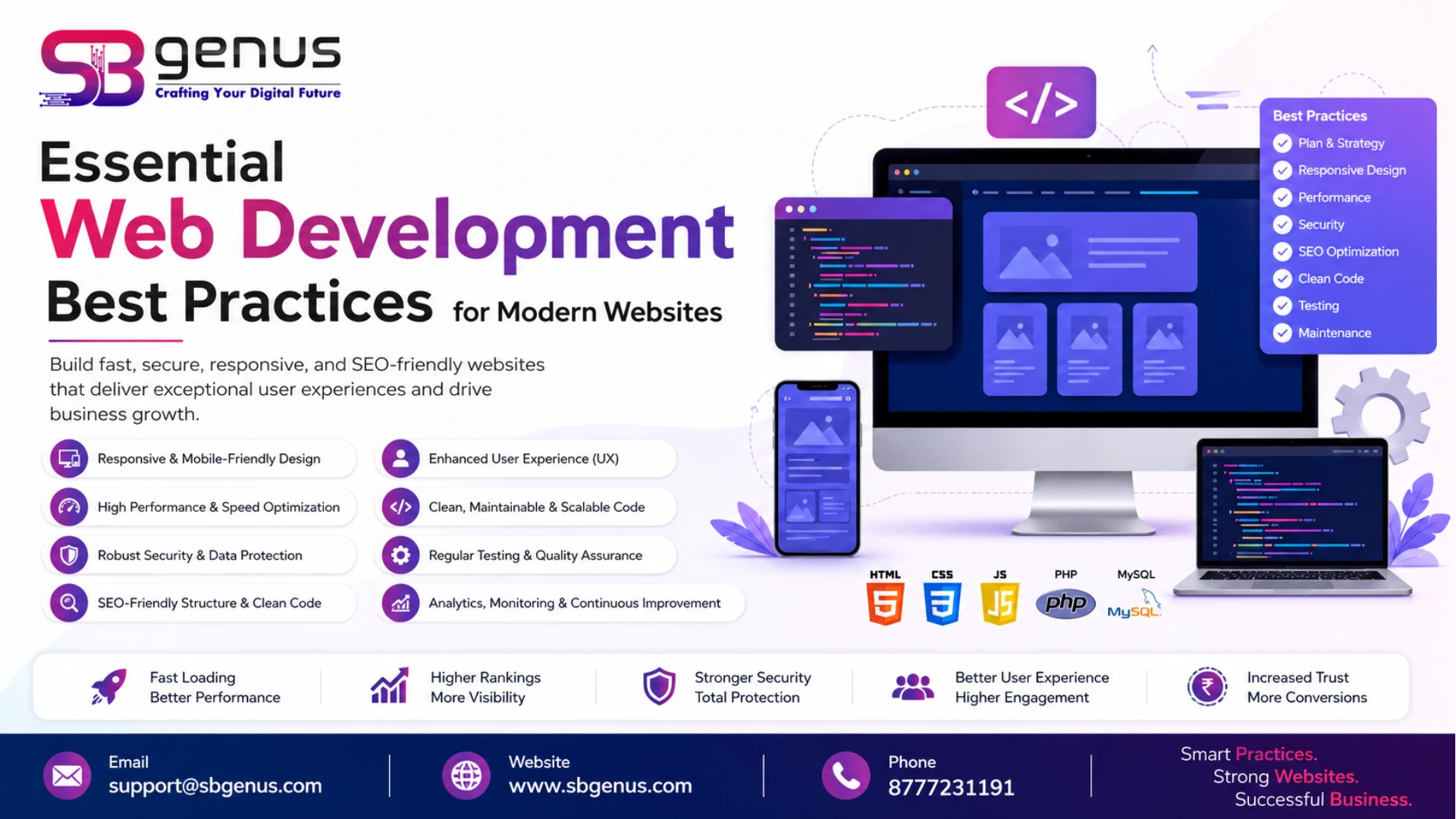
In today's highly competitive digital landscape, a website serves as much more than an online brochure. It represents a company's identity, builds trust with potential customers, and often acts as the primary source of leads and revenue. Whether it is a business website, an eCommerce platform, a portfolio, or a web application, users expect a fast, secure, and seamless experience regardless of the device they use. A poorly developed website can frustrate visitors, reduce search engine visibility, and ultimately drive potential customers to competitors.
Modern web development is no longer limited to creating visually appealing interfaces. It involves combining performance, security, accessibility, search engine optimisation, scalability, and maintainability into a single cohesive solution. As technologies continue to evolve, developers and businesses must follow industry best practices to ensure their websites remain reliable, competitive, and capable of meeting user expectations.
This article explores the essential web development best practices that every developer, business owner, and digital agency should adopt to build modern websites capable of delivering exceptional performance and long-term success.
Building a website without following established development standards often leads to technical debt, poor performance, security vulnerabilities, and increased maintenance costs. Modern best practices are designed to ensure that websites perform efficiently while remaining flexible enough to accommodate future growth.
A professionally developed website improves customer confidence, increases search engine visibility, enhances usability, and supports higher conversion rates. From a business perspective, following development standards reduces operational costs because well-structured websites require fewer fixes and are easier to update as business requirements evolve.
Furthermore, search engines increasingly reward websites that offer excellent page experience. Factors such as loading speed, mobile responsiveness, accessibility, and security directly influence search rankings, making technical excellence an important part of any digital marketing strategy.
Every successful website begins with careful planning rather than immediate coding. Before selecting technologies or designing layouts, businesses should clearly define their objectives, understand their target audience, and identify the features required to achieve their goals.
The planning phase involves organising the website structure, preparing a sitemap, determining content requirements, selecting branding elements, and establishing an SEO strategy. During this stage, developers can also identify potential technical challenges and choose suitable frameworks that align with project requirements.
Proper planning prevents unnecessary revisions during development and ensures that every page contributes meaningfully to the overall business objectives. It also creates a roadmap that keeps designers, developers, and stakeholders aligned throughout the project lifecycle.
The widespread use of smartphones and tablets has fundamentally changed the way people access the internet. Today, a significant proportion of website traffic originates from mobile devices, making responsive design an essential requirement rather than an optional feature.
Responsive websites automatically adjust their layouts, images, typography, and navigation according to different screen sizes. This adaptability ensures that visitors enjoy a consistent browsing experience regardless of whether they are using a desktop computer, tablet, or smartphone.
Google also prioritises mobile-friendly websites through its mobile-first indexing approach, meaning that responsive design directly contributes to improved search engine rankings. Businesses that fail to provide a seamless mobile experience risk losing both visitors and potential customers.
A well-designed responsive website should not merely shrink content to fit smaller screens. Instead, it should intelligently reorganise information, simplify navigation, and maintain readability while preserving functionality across all devices.
Website speed plays a crucial role in determining user satisfaction and overall business success. Research consistently shows that visitors are unlikely to wait more than a few seconds for a webpage to load. Slow-loading websites often experience higher bounce rates, lower engagement, and reduced conversions.
Performance optimisation begins with writing efficient code and minimising unnecessary scripts. Developers should compress images without sacrificing quality, implement browser caching, minimise CSS and JavaScript files, and adopt modern image formats such as WebP or AVIF wherever appropriate.
Using Content Delivery Networks (CDNs) can significantly improve loading times by serving website assets from geographically distributed servers. Similarly, lazy loading allows images and multimedia content to load only when users scroll to them, reducing initial page weight.
Database optimisation also contributes to overall website performance. Efficient queries, proper indexing, and regular database maintenance help ensure that dynamic websites continue to respond quickly even as traffic grows.
Google's Core Web Vitals have further emphasised the importance of performance by measuring loading speed, interactivity, and visual stability. Optimising these metrics not only improves SEO but also enhances user experience.
Cybersecurity has become one of the most important considerations in modern web development. As cyber threats continue to evolve, websites must implement multiple layers of protection to safeguard sensitive customer information and maintain business credibility.
The first step towards website security is implementing HTTPS through an SSL certificate, ensuring that all communication between users and the server remains encrypted. Beyond encryption, developers must validate every user input to prevent attacks such as SQL injection, Cross-Site Scripting (XSS), and Cross-Site Request Forgery (CSRF).
Strong authentication mechanisms, secure password hashing, role-based access control, and multi-factor authentication provide additional protection for user accounts and administrative systems.
Regular software updates are equally essential. Outdated frameworks, plugins, themes, and server software often contain vulnerabilities that attackers actively exploit. Consistent patch management significantly reduces these risks.
Reliable backup strategies further strengthen website security by enabling businesses to recover quickly from cyberattacks, hardware failures, or accidental data loss. Automated backups stored in secure offsite locations form an essential component of disaster recovery planning.
Search Engine Optimisation begins long before content is published. The technical foundation established during website development significantly influences how search engines crawl, index, and rank webpages.
SEO-friendly websites use clean URL structures, logical navigation, descriptive page titles, structured heading hierarchies, and properly optimised meta descriptions. These elements help search engines understand the purpose and relevance of each page.
Structured data, commonly known as Schema Markup, provides additional context that enables search engines to display enhanced search results such as FAQs, ratings, business information, and breadcrumbs. This can improve click-through rates while increasing search visibility.
Internal linking also plays an important role by distributing authority across pages and helping both users and search engines navigate the website efficiently. XML sitemaps and properly configured robots.txt files further support effective indexing and crawling.
Technical SEO should be considered a core component of web development rather than a separate marketing activity.
A visually attractive website has little value if users struggle to navigate it or accomplish their goals. User experience focuses on making websites intuitive, efficient, and enjoyable for visitors.
Effective user experience begins with clear navigation, logical page layouts, readable typography, consistent design patterns, and strategically placed calls-to-action. Every element should guide visitors naturally towards completing desired actions, whether making a purchase, submitting an enquiry, or reading additional content.
Accessibility is equally important. Modern websites should accommodate users with disabilities by following recognised accessibility standards such as the Web Content Accessibility Guidelines (WCAG). Features including alternative image descriptions, keyboard navigation, sufficient colour contrast, descriptive form labels, and screen reader compatibility make websites usable by a broader audience.
Accessibility not only demonstrates social responsibility but also improves usability for all visitors while contributing positively to search engine optimisation.
Behind every successful website lies well-organised, maintainable code. Clean coding practices simplify future updates, reduce debugging time, and improve collaboration among development teams.
Developers should adopt consistent naming conventions, modular architecture, reusable components, and appropriate documentation. Separating presentation, business logic, and database operations improves maintainability while making applications easier to scale.
Version control systems such as Git allow developers to track changes, collaborate efficiently, and restore previous versions when necessary. Code reviews and adherence to recognised coding standards further improve software quality while reducing long-term maintenance costs.
Writing scalable code ensures that websites remain adaptable as businesses expand and user demands increase.
Selecting an appropriate technology stack is one of the most important decisions during website development. The choice should depend on project complexity, expected traffic, scalability requirements, security considerations, and long-term maintenance goals rather than temporary trends.
Frontend technologies such as HTML5, CSS3, JavaScript, React, Vue, or Angular provide engaging user interfaces, while backend technologies including PHP, Laravel, Node.js, Python, Django, or ASP.NET manage business logic and server-side functionality.
Database selection also influences application performance and scalability. Relational databases like MySQL and PostgreSQL remain excellent choices for structured data, while NoSQL databases such as MongoDB offer flexibility for specific application requirements.
Carefully evaluating these technologies helps businesses build websites capable of supporting future growth without requiring costly redevelopment.
Even well-designed websites can contain hidden issues if comprehensive testing is neglected. Quality assurance ensures that every feature functions correctly before public release.
Testing should evaluate functionality, compatibility, responsiveness, performance, security, and usability across multiple browsers, operating systems, and devices. Every form, payment gateway, navigation menu, search function, and interactive component should be thoroughly examined to identify potential issues.
Performance testing simulates varying levels of traffic to ensure that servers remain stable under heavy loads, while security testing identifies vulnerabilities before they can be exploited.
Comprehensive testing reduces the likelihood of post-launch problems and contributes significantly to customer satisfaction.
Launching a website is not the end of the development process but the beginning of its operational lifecycle. Continuous maintenance ensures that websites remain secure, functional, and competitive in an ever-changing technological environment.
Regular updates should include security patches, framework upgrades, plugin maintenance, database optimisation, content improvements, broken link monitoring, and performance analysis. Monitoring website analytics also provides valuable insights into visitor behaviour, enabling businesses to identify opportunities for improvement.
Search engine algorithms, browser technologies, and user expectations continue to evolve. Businesses that actively maintain their websites are better positioned to adapt to these changes while preserving their online visibility and reputation.
The future of web development is increasingly shaped by emerging technologies such as Artificial Intelligence, Progressive Web Applications (PWAs), voice search, headless content management systems, serverless computing, and enhanced cybersecurity frameworks.
Artificial Intelligence is enabling personalised user experiences through intelligent recommendations, chatbots, and predictive analytics. Progressive Web Applications combine the capabilities of native mobile applications with the accessibility of traditional websites, delivering faster and more engaging experiences.
Meanwhile, voice search optimisation is becoming increasingly important as users rely more heavily on smart assistants and conversational queries. Businesses that embrace these technological advancements will be better prepared to meet future customer expectations while maintaining a competitive advantage.
Future-proofing a website requires continuous learning, regular updates, and a commitment to adopting proven innovations rather than merely following trends.
Modern web development is about creating digital experiences that are fast, secure, accessible, scalable, and optimised for both users and search engines. While visual design remains important, long-term success depends on the technical foundation built during development. Responsive layouts, efficient performance, strong security, clean code, SEO-friendly architecture, and continuous maintenance collectively determine how effectively a website supports business growth.
Organisations that invest in following industry best practices benefit from improved customer satisfaction, stronger online visibility, lower maintenance costs, and greater adaptability to future technological changes. As digital expectations continue to rise, adopting these essential web development practices is no longer optional—it is a fundamental requirement for building successful modern websites.
Web development best practices help create websites that are secure, fast, user-friendly, scalable, and easier to maintain. They also improve search engine rankings and enhance the overall user experience.
Responsive design ensures that a website automatically adapts to different screen sizes, providing a consistent experience on desktops, tablets, and smartphones while supporting better SEO performance.
Website speed directly affects user satisfaction, conversion rates, and search engine rankings. Faster websites reduce bounce rates and encourage visitors to stay longer.
Website security protects sensitive user data, prevents cyberattacks, maintains customer trust, and ensures compliance with modern security standards.
Technical SEO enables search engines to crawl, index, and understand website content efficiently, improving the chances of achieving higher rankings in search results.
Accessibility ensures that websites can be used by people with disabilities while also improving usability, legal compliance, and overall user satisfaction.
A website should be monitored continuously, with regular software updates, security patches, performance audits, SEO reviews, and content improvements carried out throughout the year.
Emerging trends include Artificial Intelligence, Progressive Web Applications (PWAs), voice search optimisation, headless CMS architecture, serverless computing, enhanced cybersecurity, and continuous performance optimisation using Core Web Vitals.
Trusted Clients














































































.jpg)


.jpg)
.jpg)








SB Genus is a Kolkata-based tech company specializing in custom web development, app development, digital marketing, and startup growth.


© 2017-2026 SB Genus. All rights reserved.